
Every learning organization has a favorite report. Completion rates are up. Learning gain is strong. The dashboard is green, and green feels good.
But completion tells us people finished something, and a quiz score tells us they could recall it before the forgetting curve kicked in. While both measure learning activity neither proves anyone can perform. Knowing and performing are fundamentally different outcomes. Learning science distinguishes them as declarative knowledge (knowing what) and procedural knowledge (knowing how). What happens in the space between them is where things get interesting.
I was reminded of this recently when my doctor told me I needed a hip replacement. After many years of distance running on hard surfaces, my body had finally pulled the plug. In my search for an orthopedic surgeon, I found myself thinking about the difference between declarative knowledge and procedural knowledge. Several people told me all about their hip replacement, some with impressive knowledge of the materials and the procedure. But you really want a surgeon who has performed the procedure many times. Many, many times. Declarative knowledge got him through medical school, but procedural knowledge, years in residence, years of guided practice made me feel safe in his hands. You get procedural knowledge through practice.
Start with performance, not knowledge.
Like many learning organizations, Ander starts with performance. That begins with defining what capable performance looks like in observable terms. Not “understands the sales process,” but “uncovers three customer needs before presenting a solution.” If you can’t see it on the job, you can’t develop it with any confidence. If you can’t observe it, you can’t measure it. And you’re going to want to measure it, believe me.
Close the knowing-doing gap with practice and coaching.
While practice gives people realistic repetitions where mistakes are cheap, coaching turns those reps into improvement. Most people would prefer a manager who observes and gives helpful feedback rather than another training module.
Let Performance Intelligence guide what comes next.
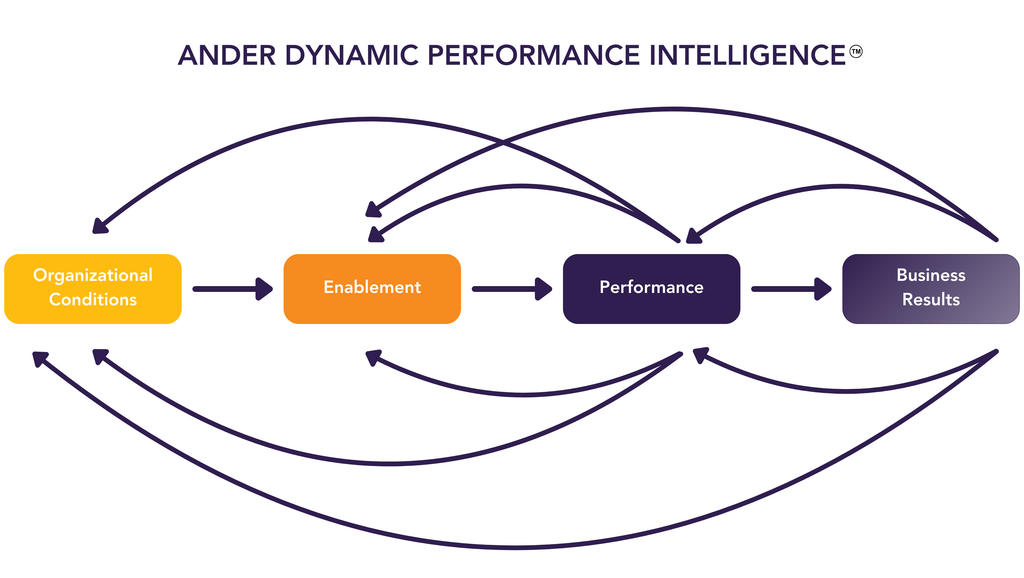
What sets Ander apart is Performance Intelligence: connecting what people know, what they do on the job, and what the business produces, so learning and support are personalized to each individual and keep adapting as their performance changes. In FUEL, our learning and performance platform, that means merging learning data, what people know and have practiced, with performance data, what they’re actually achieving on the job. When the two don’t line up, that gap becomes a signal. It shows who needs a refresher, who needs coaching, and who simply needs the right resource at the moment of need. The support adapts to how people prefer to learn, too. With five generations at work, some want a simulation, some a quick video in the flow of work, some a seasoned colleague at their side. The format can flex, but the standard of performance can’t.
At Ander, we see it simply: learning is an input, performance is the outcome, and the space between them is intelligence we can act on. The real question isn’t whether they learned it. It’s whether they can do it, consistently, when it counts.
See how Performance Intelligence connects learning data to on-the-job results
About The Author
Paul Flynn is Vice President of Learning Design & Performance at Ander. A performance improvement expert with more than 30 years of experience, he has built award-winning learning solutions that move real business metrics across education, biomedical services, and retail and commercial automotive.